202106/15週二演講[線上演講] Applications of Data Analytic Modeling for Seizure Prediction陳翔瀚博士Department of Psychiatry, Washington University in St. Louis10:30 – 12:00線上演講
Abstract:
Data analytic modeling for seizure prediction using intracranial electroencephalogram (iEEG) signal has attracted significant attention over recent decades. However, there are no technologies that can achieve accurate seizure prediction, in particular online prediction. This talk presents a novel system for online prediction of lead seizures, in which several new technologies for addressing challenges of modeling were applied.
202105/27週四演講[演講延期] Robust score test for treatment effects for paired continuous and categorical data鄒宗山教授國立中央大學統計研究所15:30 – 17:00鴻經館 M107
[因為疫情關係,演講延期,時間待訂]
Abstract:
We develop a score statistic for testing the difference between two treatment effects for paired continuous and categorical responses. The test is legitimate in the presence of within-pair correlation and for general marginal distributions. Simulations show that our new method outperforms the generalized linear mixed model (GLMM) in terms of performance measures most concerned.
202105/13週四演講[演講延期] Distributed Compressive Sensing: Performance Analysis With Diverse Signal Ensembles梁惟㨗教授東海大學應用數學系15:30 – 17:00鴻經館 M107
[因為疫情關係,演講延期,時間待訂]
Abstract:
Distributed compressive sensing (DCS) is a framework that considers joint sparsity within signal ensembles along with multiple measurement vectors (MMVs). However, current theoretical bounds of the probability of perfect recovery for MMVs are derived to be essentially identical to that of a single MV (SMV). In this talk, I will introduce two key ingredients, called “Euclidean distances between signals” and “decay rate of signal ensemble,” to conduct a performance analysis of a deterministic signal model under the MMVs framework.
202104/08週四演講How to embed a data manifold by using locally linear maps?陳志偉教授國立中山大學應用數學系15:30 – 17:00鴻經館 M107
Abstract:
A data cloud with special pattern can be seen as a high dimensional (sub-)manifold and its features can be detected via various dimensionality reduction maps. Mechanisms of some well-known maps, such as LLE and HLLE, will be discussed in this talk. With Dr. Liren Lin, we propose a Tangential LLE which can capture intrinsic structure of the data manifold while LLE/HLLE fails or is non-applicable.
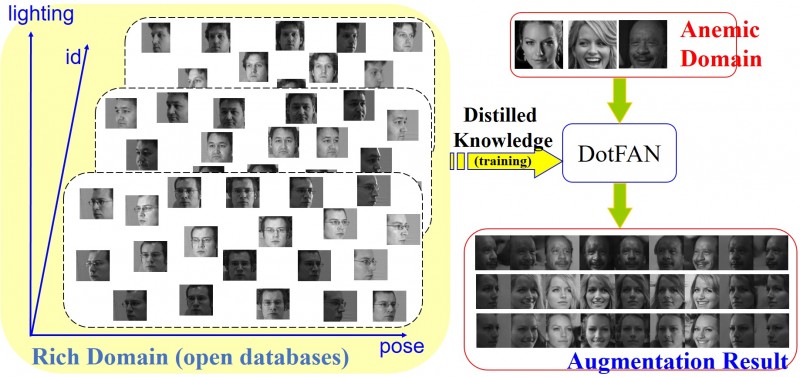
202103/02週二演講DotFAN: Domain-Transferred Face Augmentation Network邵皓強教授輔大統計資訊學系10:30 – 12:00鴻經館 M107
Abstract:
The performance of a convolutional neural network (CNN) based face recognition model largely relies on the richness of labeled training data. However, it is expensive to collect a training set with large variations of a face identity under different poses and illumination changes, so the diversity of within-class face images becomes a critical issue in practice. In this paper, we propose a 3D model-assisted domain-transferred face augmentation network (DotFAN) that can generate a series of variants of an input face based on the knowledge distilled from existing rich face datasets of other domains. Extending from StarGAN's architecture, DotFAN integrates with two additional subnetworks, i.e., face expert model (FEM) and face shape regressor (FSR), for latent facial code control. While FSR aims to extract face attributes, FEM is designed to capture a face identity. With their aid, DotFAN can separately learn facial feature codes and effectively generate face images of various facial attributes while keeping the identity of augmented faces unaltered. Experiments show that DotFAN is beneficial for augmenting small face datasets to improve their within-class diversity so that a better face recognition model can be learned from the augmented dataset.